Agentic Commerce
Shipping Privacy at Scale with Universal Commerce Protocol (UCP)

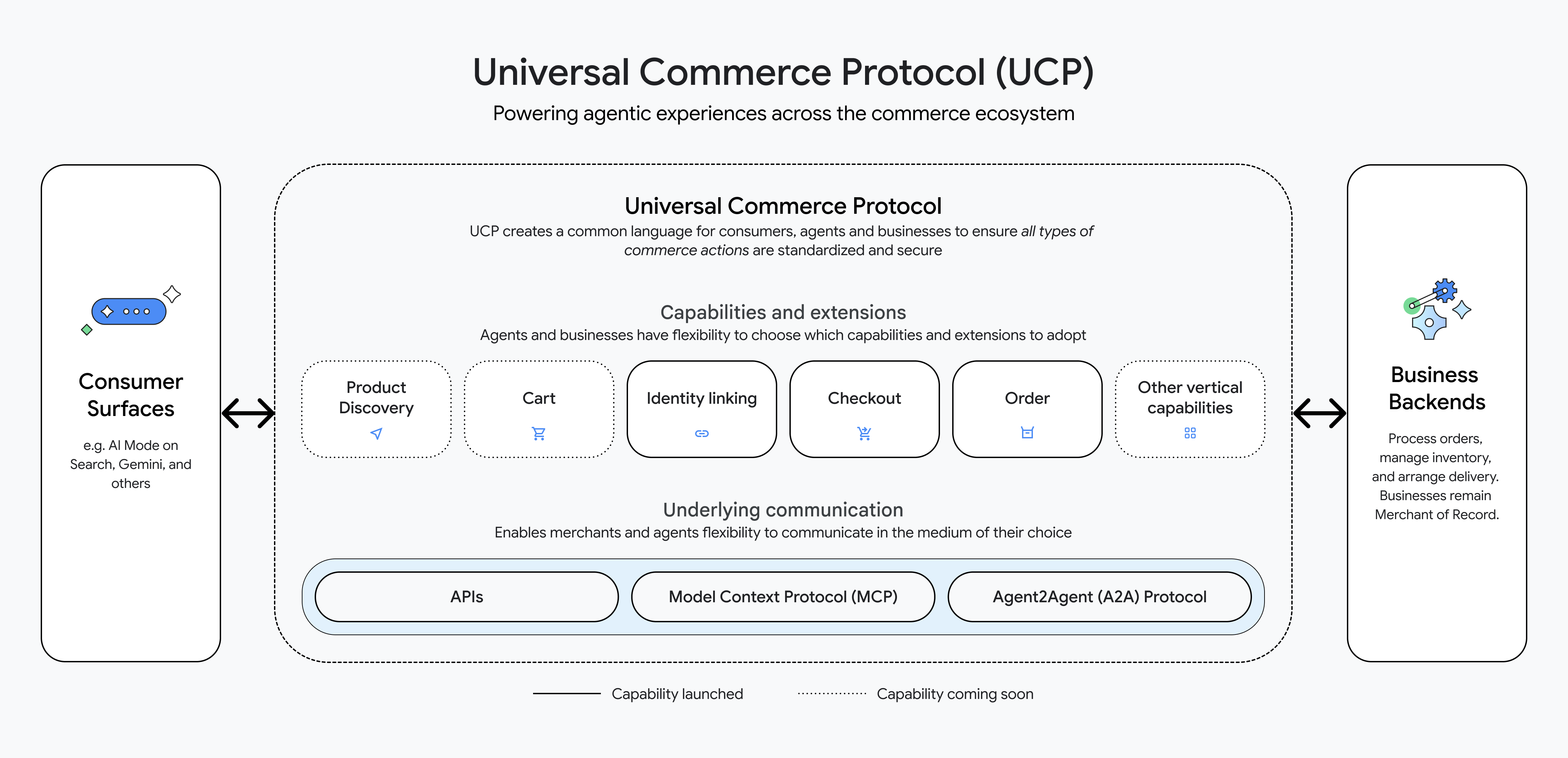
Image from Google’s Announcement
Why UCP Matters
The Universal Commerce Protocol promises an open-source standardized way to share commerce signals across an ecosystem that includes merchants, publishers, and platforms.
For consumers, it can enable conversational shopping. When paired with other technologies, researching, to choosing a product or service, all the way through checkout can happen over a chat.
For AI and data leaders, that means unlocking measurement and orchestration without leaning on sprawling third-party identifiers.
Key Considerations
Start with Purpose
If you cannot write down a crisp purpose for every UCP event you plan to emit or ingest, you’re not ready. Treat purpose like a contract with your users and regulators. Build a purpose inventory that maps each event to a lawful basis, a consent signal, a retention window, and the teams who can touch it (access).
Minimize Collection Plans
UCP’s promise isn’t a license to collect more. It’s an invitation to collect less and get more from it. Drop optional fields unless they directly serve your purpose. Aggregate wherever you can. Data you never collect never leaks.
Linkability Is the New Attack Surface
Even hashed or pseudonymous data can be re-identified through combinations of rare SKUs, timestamps, or locations. Prefer transient, context-limited identifiers, rotate keys aggressively, and cap the resolution of events. Stress test your setup with re-identification exercises and shut down the joins that shouldn’t be possible.
Consent
Wire your SDKs and server endpoints so consent toggles immediately suppress event creation, transmission, and downstream processing. For multi-region deployments, align consent UX to local law and document the legal basis per purpose.
Add the Guardrails
If UCP signals feed your models, register each use case in your AI inventory and lock in a feature allowlist. Ban sensitive inference targets and run pre-deployment bias and privacy leakage tests. Publish transparency reports (model cards/system cards) that record UCP provenance, retention windows, and constraints.
Respect Borders
If any UCP data crosses borders, run transfer assessments, use the right contractual scaffolding, and keep processing regional where possible. Don’t let “just for troubleshooting” become a backdoor for global access.
Prep for An Incident Before You Have One
Incidents will happen. Extend your playbooks to cover schema abuse, protocol poisoning, and key compromise. Coordinate with partners so you know who to call.
How to Launch in 30–60 Days
Week 1: Map data flows, draft the purpose inventory, and pick your initial use case(s).
Week 2: Implement consent gating, schema allowlists, and retention policies.
Week 3: Harden transport and keys; run re-identification and privacy leakage tests.
Week 4: Complete role mapping and contracts; finalize regional processing paths.
Week 5–6: Register models, produce model/data cards, conduct tabletop incident drills, and bring the AI Governance committee together to make a decision on whether the project is ready to launch.
Bottom Line
UCP can be a force multiplier for commerce analytics and AI. Treat purpose as a product requirement, build minimization into your schemas, and pressure-test linkability like it’s your top security risk. Do that, and you’ll ship faster, stay compliant, and keep trust intact. Execute on these controls to capture measurement gains without trading away compliance or user trust.